Some links on this page are affiliate links. If you sign up through them, we may earn a commission at no extra cost to you. It never changes how we rank a tool.
You hired someone on Upwork. They ghosted after three weeks. Or they stayed, but every task needed a miniature briefing, and you spent more time explaining the work than doing it yourself.
The problem is usually not delegation. It is hiring a generic admin VA for a creator-native job, through a model that leaves you carrying all the vetting and replacement risk.
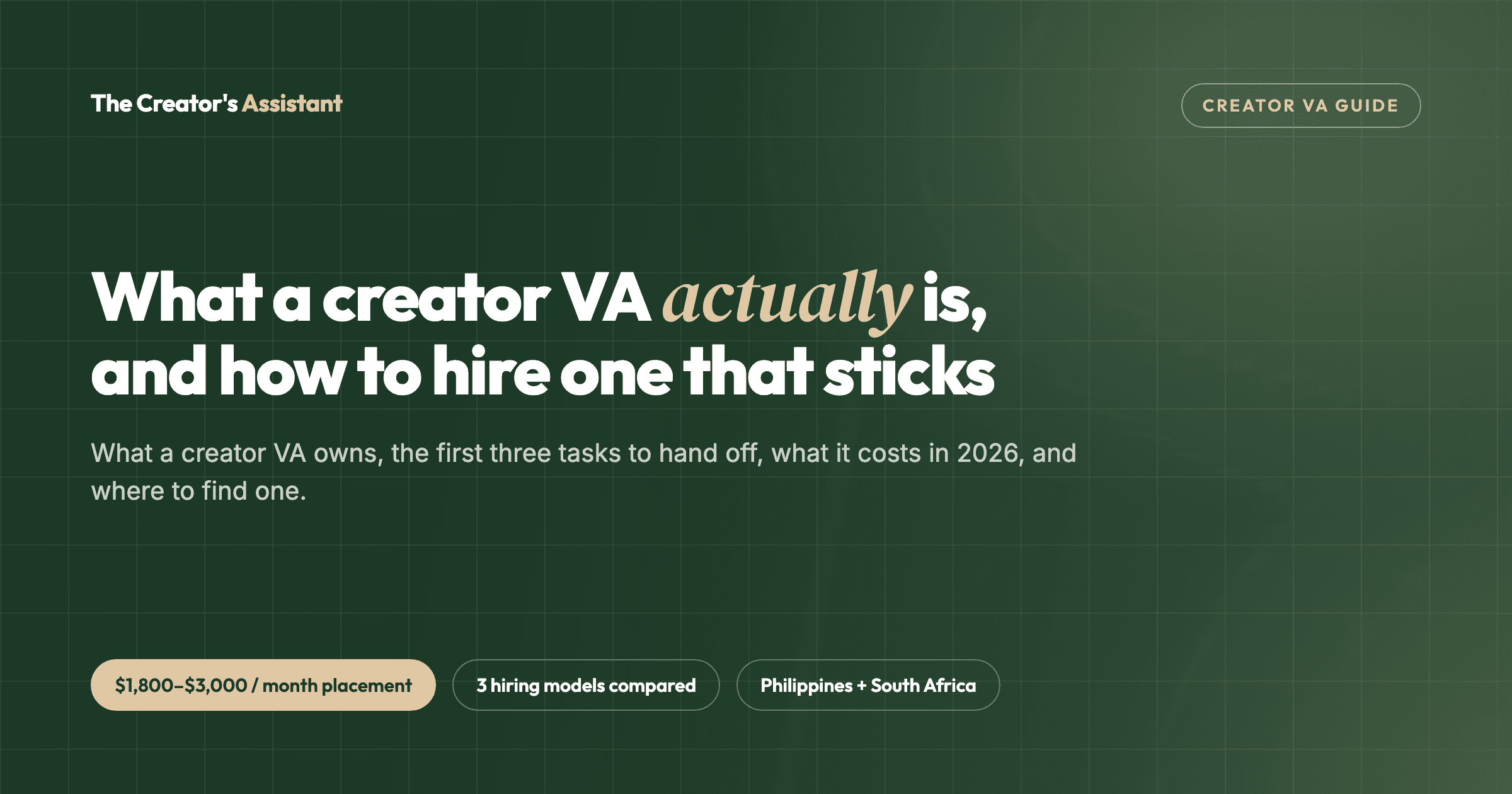
A creator VA, also called a creator virtual assistant or content creator assistant, handles the recurring work around your content business. That can include inbox triage, publishing, sponsorship administration, guest coordination, repurposing, and audience communication. The right scope depends on whether you are a YouTuber, podcaster, course creator, or coach.
There are three practical ways to hire one:
- A freelance marketplace gives you the lowest sticker price, but you handle sourcing, vetting, management, and replacement.
- A managed hourly platform handles more of the hiring process, but you usually pay for capped hours and may not get one fully dedicated person.
- A flat dedicated placement gives you one full-time, long-term hire. At TCA, that costs $1,800 to $3,000 per month, all-inclusive, for talent sourced from the Philippines or South Africa.
A well-matched assistant can become more useful over time because they learn your tools, standards, audience, and publishing rhythm. Justin Welsh has written that his VA saves him about 40 hours a month, an example of what can happen when one person stays close to the work long enough to understand it.
Rather not hire solo?
We match you with a dedicated, creator-native VA in 14 days or less. Flat monthly, all-inclusive, and one long-term teammate who learns your channel.
Creator VA vs. Generic Admin VA: The Difference That Actually Matters
Every VA can manage a calendar. Far fewer can manage the workflow behind a YouTube upload, podcast episode, course launch, or sponsorship.
A generic admin VA may handle calendar updates, inbox sorting, data entry, and CRM upkeep. A creator VA handles them with the context of your content business.
That context changes the output:
- A generic VA schedules a YouTube upload. A creator VA checks the description, chapters, end screens, thumbnail, sponsor requirements, and publishing checklist before scheduling it.
- A generic VA posts a Short you hand over. A creator VA understands that short-form content can come from your long-form library and can move the clip through a repeatable repurposing workflow.
- A generic VA books a podcast guest. A creator VA coordinates the guest, prepares the production handoff, tracks show notes, and helps distribute the finished episode.
- A generic VA forwards a brand email. A creator VA can identify the deal stage, flag missing information, track the deliverables, and prepare the next follow-up.
“Virtual assistant” is an umbrella title, not a skill set. Hire for the work you need done, then test the individual’s judgment and communication.
A creator VA may work inside a toolchain that includes YouTube Studio, a podcast RSS host, Frame.io, Descript, Canva, sponsor portals, affiliate dashboards, and a shared project tracker. They do not need to master every tool before starting. They do need to understand how the tools connect to your publishing process.

What a Content Creator Assistant Owns, by Creator Type
A content creator assistant, or CCA, should own clearly defined workflows, not an endless list of disconnected tasks. Start with recurring, documentable, low-judgment work. Keep strategy, creative direction, and final approval until the person earns more autonomy.

YouTubers
A YouTube-focused creator VA can own:
- The upload checklist, including descriptions, chapters, end screens, cards, scheduling, and thumbnail uploads
- Comment moderation and escalation of messages that need your voice
- Thumbnail research briefs and title options
- Sponsor outreach, brief tracking, invoicing, and payment follow-up
- Lead-magnet links and landing-page quality checks connected to each video
- Repurposing long-form videos into Shorts and social posts
- Basic analytics collection for your review
YouTube’s native Test & Compare feature can test thumbnail variants and, on supported surfaces, titles. Your assistant can help prepare the variants and record the results, while you keep the final creative call.
Podcasters
A podcast VA can own:
- Guest research, outreach, scheduling, and confirmations
- Recording reminders and guest preparation documents
- The editing handoff and review checklist
- Show notes, timestamps, links, and episode descriptions
- RSS distribution and publishing
- Short-form clips and cross-platform posts
- Listener inbox triage
The useful handoff is the whole chain. If the assistant only books guests but nobody owns the follow-up, recording files, show notes, or publishing, you still remain the project manager.
Course creators
A course creator may delegate:
- Lesson and announcement scheduling
- Student inbox triage using approved replies
- Content organization inside the learning platform
- Repurposing lesson clips into social content
- Launch checklists and deadline tracking
- Affiliate or partner follow-up
Keep curriculum decisions, teaching, and changes to the promise of the course with you.
Coaches
A coach can hand off:
- Calendar management and appointment reminders
- Client onboarding paperwork
- Intake-form checks and follow-up
- Call recordings and resource delivery
- Social posts repurposed from approved calls or lessons
- Inbox and direct-message triage
Access needs extra care here. Give the assistant only the client and business information required for the tasks they own.
Sponsorship and revenue administration
Sponsorship administration deserves its own workflow. Gospel Stats, reported by Tubefilter, counted 65,759 sponsored YouTube uploads in the first half of 2025, with views reaching about 19.1 billion.
A creator VA can manage the operational side:
- Maintaining a prospect and partner list
- Tracking outreach and replies
- Preparing draft briefs from your templates
- Recording deliverables and deadlines
- Preparing invoices
- Following up on unpaid work
You should keep final approval of rates, contracts, claims, sponsor scripts, and any promise made in your name.
The First Three Tasks to Hand Off
Do not give a new assistant 30 tasks on day one. Start with three connected workflows and let the person learn how you work.
1. Inbox and direct-message triage
The assistant reads, categorizes, drafts replies from approved templates, and flags anything that requires your judgment.
Set rules for:
- Sponsorship inquiries
- Press requests
- Client or student messages
- Fan questions
- Sales opportunities
- Personal or sensitive messages that stay with you
Keep approval on outgoing replies at first. The goal is a safe review loop.
2. The platform-specific publishing workflow
The second task depends on your creator type:
- YouTuber: upload checklist, metadata, chapters, thumbnail, end screens, and scheduling
- Podcaster: guest confirmations, show notes, RSS publishing, and distribution
- Course creator: lesson scheduling, student announcements, and platform checks
- Coach: calendar, client onboarding paperwork, and approved content delivery
Give the workflow a clear owner. “Help with publishing” creates uncertainty. “Own the YouTube upload checklist from final export to scheduled release” is a real responsibility.
3. Sponsorship or revenue administration
Once the first two workflows are stable, hand over the operational side of brand deals, affiliate links, invoices, or partner follow-up.
Three tasks is a useful ceiling for the first month. Add more only after the assistant can run the first three without you stepping into every decision.
Who to Hire First: VA vs. Social Media Manager vs. Editor vs. OBM
These roles overlap, but they do not solve the same problem.

- A VA executes defined tasks, maintains workflows, and escalates anything outside the agreed scope.
- A social media manager owns social strategy, content direction, publishing decisions, and audience engagement.
- A dedicated video editor owns post-production across a steady volume of footage. If editing is the bottleneck, a VA juggling publishing, inboxes, and sponsorships is unlikely to fix it. See our guide to the dedicated video editor role.
- An OBM, or online business manager, is a strategic operations partner who makes decisions, manages systems, and may coordinate other people.
For many creator-led businesses, a flexible VA is the practical first hire because the role can absorb several recurring workflows. Add specialists when a specific bottleneck becomes large enough to justify a dedicated role.
Start with an editor instead when the content calendar is blocked by post-production. Start with a social media manager when the central problem is channel strategy and daily audience growth. Start with an OBM when you already have people and systems that need coordination.
What a Creator VA Costs in 2026: Hiring Models Compared
The rate is only one part of the decision. You are also choosing who handles sourcing, vetting, management, replacement, and the cost of a person learning your workflow.

| Hiring model | Typical price or cadence | What you handle | Main tradeoff |
|---|---|---|---|
Freelance marketplace | $9 to $38 per hour | Sourcing, screening, briefing, payment, quality control, and replacement | Lowest sticker price, highest responsibility |
Managed hourly platform | Around $1,299 per month for about 4 hours per day | Defining the workflow and managing the work | Capped hours and possible rotation between staff |
Flat dedicated placement | $1,800 to $3,000 per month, all-inclusive, for one full-time long-term placement | Providing context, feedback, and access | Full-time commitment and a higher starting price |
US in-house hire | Much more once payroll taxes and benefits are loaded | The full employment and management process | Highest cost, with closer time-zone collaboration |
Freelance marketplace fees vary by contract. Upwork’s freelancer service fee has been variable from 0% to 15% since May 1, 2025, according to its current fee documentation. Check your own management time and any client-side costs before you compare a quote with a monthly placement. The figures above reflect a published provider claim.
TCA operates in the flat dedicated placement category. We place full-time talent from the Philippines and South Africa at $1,800 to $3,000 per month, all-inclusive, for one dedicated long-term hire. The lower end reflects a strong generalist with about five years of experience. The higher end reflects a specialist with five to ten or more years directly in the client’s niche.
That is our owned interest, so compare it honestly with the other options. A marketplace may be a better fit for a one-off task or a small, irregular workload. A managed hourly model may suit you if you need flexible capacity and do not need one full-time person. Dedicated placement makes more sense when the same person can own a meaningful set of workflows every week.
For regional context and a broader overseas VA cost breakdown, see our guide to how much an overseas VA costs.

Where to Find a Creator VA
Freelance marketplaces
Upwork and Fiverr can work for project-based tasks, short trials, or creators who are comfortable screening candidates themselves. OnlineJobs.ph is another option for direct hiring in the Philippines.
Expect to review portfolios, clarify availability, run interviews, set a paid test, check references where appropriate, and write the operating instructions yourself. The headline rate does not include those hours.
Managed hourly platforms
A managed platform can reduce the sourcing and initial vetting work. You still need to define the role, explain your tools, review the work, and decide whether the arrangement gives you the continuity you need.
Ask these questions before signing:
- Is the person dedicated to your account during the paid hours?
- Who handles absence or replacement?
- Do you communicate directly with the assistant?
- What does onboarding include, and what remains your responsibility?
Dedicated placement
A dedicated placement is for creators who want one full-time teammate rather than a succession of task-based freelancers. TCA’s process includes a paid trial before placement, placement within 14 days or less from the first call to the placed person’s first day, and a 30-day replacement guarantee if the hire is not right.
Talent is sourced from the Philippines and South Africa. If time-zone overlap is central to your workflow, compare the countries and working hours against your actual production calendar. Batched async work, live recording days, and launch support create different requirements. Our best-country guide covers that decision in more detail.
Why Dedicated Hires Stay Useful
The strongest reason to keep one person is accumulated context, not a retention statistic.
A long-term assistant learns:
- Which messages need your reply
- How your audience talks
- Where each asset lives
- Which sponsor deadlines are real
- What “ready to publish” means to you
- Which mistakes are expensive
That knowledge cuts the briefing needed for recurring work.

A cheap hire becomes expensive when you repeatedly restart the relationship. Replacement is only part of the cost. You also re-explain your tools, standards, audience, and decision rules.
Fair pay matters for the same reason. Pay for skill and scope, not simply the lowest available country rate. An assistant who is treated as disposable has little reason to invest in the systems and judgment that make the role more valuable.
You also have responsibilities as the client. Pay on time, give specific feedback, share the context needed to make decisions, and do not keep adding work without changing the scope.
Red Flags Before You Sign
A polished portfolio is not enough. Test how the person thinks and communicates.
They refuse a paid trial
A paid trial should use a real, bounded creator task. Refusal is a clear signal that the arrangement may not fit.
They cannot explain their portfolio
Ask the candidate to choose one piece and explain the brief, their process, the tools they used, and one decision they would change. You are testing ownership and judgment more than visual polish.
They claim expertise in everything
A candidate who says they are equally advanced at editing, paid ads, funnels, public relations, email automation, design, and analytics may be describing ambition rather than capability.
Ask: “Which two skills are strongest, and which tasks would you not want to own as your primary responsibility?”
They never ask questions
A creator workflow contains ambiguity. Someone who agrees with every instruction but never checks assumptions may guess silently later.
Ask: “What would you clarify before starting this task?”
Their availability is unclear
Agree on working hours, response expectations, overlap, and planned time off before the trial. A vague schedule becomes a recurring coordination problem.
For a longer interview bank, use our overseas VA interview questions. You can also review the broader red flags when hiring an overseas VA.
How to Hire and Onboard a Creator VA
Before the trial
Write down:
- The three workflows the person will own first
- The result each workflow should produce
- The tools and accounts involved
- Examples of work you consider good
- What requires your approval
- How you will give feedback
- The expected working hours and response window
Record short walkthroughs for steps that are hard to capture in writing. Include file names, folder locations, naming rules, and what to do when something is missing.
Run a paid trial
Use a real task with a limited scope. For example, ask the candidate to organize a recent upload checklist, draft approved replies to a small set of inbox messages, or prepare titles and descriptions from a finished video.
Assess:
- Whether they follow the brief
- Whether they ask useful questions
- Accuracy and attention to detail
- Communication during the task
- File organization
- How they respond to feedback
- Whether they identify a problem before you point it out
Do not turn a trial into unpaid production. Pay for the work and keep the scope clear.
Days 1 to 30: foundation
Start with the lowest-risk recurring tasks. Review work frequently and give timestamped or line-specific feedback. Keep approval on sensitive messages, sponsor terms, client information, and public claims.
TCA runs onboarding through the first 30, 60, and 90 days, with client input throughout. Platform access can be set up quickly, but understanding your particular standards takes longer.
Days 31 to 60: ownership
Move from task completion to workflow ownership. The assistant should be able to run the agreed process, identify missing inputs, and escalate exceptions without waiting for instructions at every step.
Review the SOPs during this period. If the same question appears twice, improve the documentation instead of answering it from scratch forever.
Days 61 to 90: improvement
By this stage, the assistant should be proposing small improvements to the workflows they own. That could mean reorganizing a tracker, tightening an approval step, or identifying a recurring publishing error.
Do not confuse independence with permission to make every strategic decision. The assistant owns the agreed process. You retain the decisions that affect brand, money, clients, and creative direction.
For a deeper onboarding sequence, see how to onboard an overseas VA.
Account Access and What to Do When It Is Not Working
Give access in stages.
- Use a password manager with shared vaults instead of sharing raw passwords.
- Use role-based permissions wherever the platform supports them.
- Turn on multi-factor authentication for email, analytics, payment, sponsor, and advertising accounts.
- Give access only to the systems required for the person’s current tasks.
- Put confidentiality expectations in writing before sensitive access is granted.
- Keep an offboarding checklist that covers vault access, user roles, connected apps, and shared files.
Verizon’s 2025 Data Breach Investigations Report found that about 60% of breaches involved a human element. That figure is broad and does not predict your individual risk, but it shows why access controls and clear procedures matter.
When performance slips, diagnose before replacing:
- Bad month: The person usually performs well, and the problem has a specific cause. Coach and adjust the process.
- Bad fit: The work is acceptable, but the communication style, availability, or scope does not fit. Discuss a change in expectations or responsibilities.
- Bad hire: The person repeatedly misses agreed standards, cannot be trusted with the work, or shows several red flags after feedback. Replace them.
If a TCA placement is not right in the first 30 days, our replacement guarantee applies at no additional cost.
Which Model Is Right for You?
Choose a freelance marketplace if you need project-based support, have a limited budget, and can manage the hiring and replacement process yourself.
Choose a managed hourly platform if you want help with sourcing and flexible, capped support, and you are comfortable clarifying whether the arrangement provides one person or a pool.
Choose flat dedicated placement if you want one full-time teammate to learn your creator business and own recurring workflows over the long term. This is the category TCA operates in, with a paid trial, a 14-day-or-less placement guarantee, and a 30-day replacement guarantee.
A dedicated placement is not the right call if you need one-off task work, irregular project support, or only a few hours a week. Another model may fit those constraints better.
Creator VA FAQ
How much does a creator VA cost?
TCA places one full-time, dedicated long-term hire for $1,800 to $3,000 per month, all-inclusive.
How long does it take to hire one?
TCA’s placement timeline is 14 days or less from the first call to the placed person’s first day. A self-managed marketplace search has no fixed timeline because it depends on your sourcing, screening, paid trial, and availability.
What happens if the match fails?
TCA offers a 30-day replacement guarantee if the hire is not right in the first 30 days. With a marketplace hire, you generally need to manage the replacement process yourself.
Should I hire one generalist or several specialists?
Start with one generalist when your main problem is scattered recurring work and you do not yet have stable systems. Split the role when a specific function, such as editing or social strategy, becomes a large enough bottleneck to justify a specialist.
Is hiring offshore exploitative?
The ethical standard is straightforward: pay for the skill and scope, not the lowest possible country rate. Be clear about hours, expectations, payment timing, feedback, access, and the work the person is actually being asked to do.
If you are ready for a dedicated, full-time creator VA, tell us what you need. We will explain whether the model fits before you decide.