Some links on this page are affiliate links. If you sign up through them, we may earn a commission at no extra cost to you. It never changes how we rank a tool.
I've interviewed hundreds of VA candidates across the Philippines and South Africa, and I've watched founders make the same hiring mistakes on repeat. The biggest one is treating the interview like a skills test. It's not. Skills tests are for skills. The interview is where you assess communication, culture fit, problem-solving, and whether this person is still working with you 12 months from now.
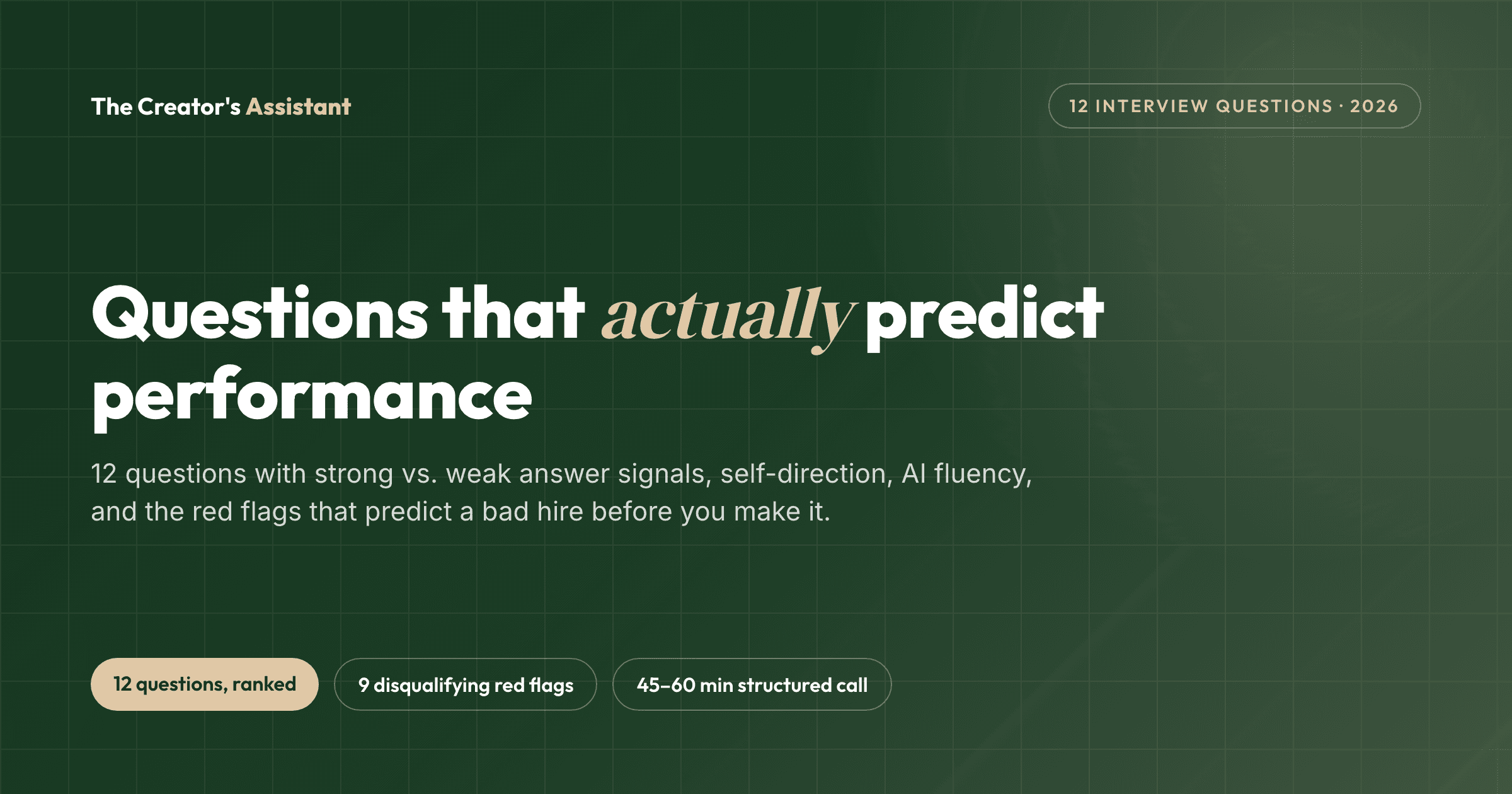
Most articles on overseas virtual assistant interview questions dump 30 generic prompts and walk away. None of them tell you what a strong answer sounds like vs. a weak one. This piece gives you 12 questions with the structure to run them. Hiring an executive assistant? Use our executive assistant interview questions.
Here's how to set the call up so the questions actually work.
Block 45 to 60 minutes. Always video, never email-only (refusing video is a red flag in 2026). The flow that works: 5 minutes of warm-up, 10 to 15 minutes on background, 15 to 20 minutes on skills plus one live 10-minute work-sample, 10 to 15 minutes on cultural and operational fit, 5 to 10 minutes on logistics, 5 to 10 minutes for their questions.
Two techniques will change your hit rate. First, when you want depth, don't ask a new question. Say "tell me more." That's it. Candidates reveal real thinking when you create space rather than redirect them. Second, leave 3 to 5 seconds of silence after each question. Filipino candidates in particular often need processing time, and silence pulls out real thinking instead of a rehearsed line.
One rule: never ask "do you understand?" It triggers an automatic yes. Ask "walk me through your first three steps" instead. And when an answer sounds rehearsed, ask "tell me about the exact last time you dealt with that." Borrowed knowledge can't answer that one.
Below: 12 questions ordered the way you should actually run them, each with question wording, why it works, what strong and weak answers sound like, and a follow-up. Start with the question that sets the tone for the whole call.

Skip the hiring grind.
We place a dedicated, fully vetted overseas VA from the Philippines or South Africa in 14 days or less. Flat monthly, all-inclusive, matched to your role.
1. Tell me about a time you had to figure something out completely on your own
This is the first question I ask every candidate. Self-direction is the single biggest predictor of success in async overseas work, and it can't be answered with a scripted resume. It forces a specific story.
A strong answer gives a concrete situation you can verify. Client type, tools they tried, timeframe, what they attempted before asking for help, and the outcome. Good or bad, they'll share what they learned. The best version names the actual tool they Googled their way into ("I taught myself Descript in a weekend because the client's editor quit two days before launch") and what broke along the way.
Weak answers stay in hypotheticals: "I would just Google it." Or worse, they default immediately to "I would ask the client." That's not self-direction. That's task-passing.
Watch for AI-script structure too. Context, claim, list, conclusion, no personal specifics. That's ChatGPT writing through them.
Follow-up: "What would you have done differently now?" Borrowed knowledge can't answer that one. Real experience can.
2. Walk me through your internet and power backup situation
Zero tolerance for vagueness here. The Philippines has typhoon-season outages. South Africa has Eskom load-shedding (Stage 1 through 8 rolling blackouts). This question separates experienced overseas VAs from new ones who haven't been burned yet.
What a strong Philippines answer sounds like:
- Primary fiber ISP plus a mobile hotspot as backup
- UPS battery for the workstation
- Knows current speed (50+ Mbps down, 10+ up) and can send a Speedtest screenshot
- Cites local outage frequency and has a contingency plan
What a strong South Africa answer sounds like:
- Fiber plus UPS plus a co-working space option for multi-hour outages
- Knows the current load-shedding stage in their area
- Has a documented plan for when stage 4+ kicks in
Weak answer: "I have WiFi." No backup. No UPS. Doesn't know their own internet speed.
Pro tip: Ask for a Speedtest screenshot before the call. It pre-filters half the applicants without you spending interview time on infrastructure.
Follow-up: "How often do you have outages, and what happened to a client deliverable the last time you lost power?"
3. What are your regular working hours, and when are you NOT available?
I've watched founders get blindsided in December because their Philippine VA observed Bonifacio Day (November 30) and Rizal Day (December 30) and they didn't know to plan around it. This question prevents that.
It also tests realistic self-knowledge. "I can work any hours you need" is a red flag. It signals poor boundaries that produce burnout and ghosting within 60 days. Strong overseas VAs know their own hours.
A strong answer gives you specific hours in a specific timezone (PHT or SAST), names the overlap window with your timezone, and mentions blackout periods. Family commitments, religious observance, public holidays they observe.
A weak answer is the "whatever works for you" line with no specifics, or no awareness of their own holiday calendar.
Follow-up for Philippines: "The Philippines observes Bonifacio Day on November 30 and Rizal Day December 30. What's your plan for client work that week?" For South Africa, sub in Heritage Day (September 24) or Day of Reconciliation (December 16).
4. What happened with your last client engagement, and why did it end?
A character trap is built into this question. Honest candidates explain what actually happened (project ended, client scaled down, needs changed) without trashing the client. They describe what they learned and they can name specifics: industry, length, type of work.
Watch out for the candidate who blames the client for everything with no self-reflection. That pattern is a tell.
Disqualifying: blames every previous client for every problem. If all their past clients were terrible, you're next.
Follow-up: "What did you wish you'd known at the start of that engagement?" This forces specific, non-rehearsed reflection. Scripts collapse here.
We run this exact question on every candidate before we ever present them. The answer pattern across multiple past engagements is one of the strongest 12-month retention predictors we've found. Resume length is not.
5. Show me a sample of your best work and tell me what you specifically did
Founders get burned by stolen portfolio samples constantly. Fake identities reuse real work and fabricated case studies, and the only way to catch it is in the interview. Borrowed work collapses under specific follow-ups.
A strong candidate opens the sample live in the interview. They walk through their specific contributions, name the client and platform, and answer detailed follow-up questions about edits, decisions, or trade-offs. If they're an executive assistant, they show a real Notion or calendar workflow. If they're a video editor, they walk through cut decisions.
Weak: sends a link they can't speak to in detail. Describes work in generic terms. Can't name the client. Hedges on what they did versus what the team did.
Disqualifying: refuses to screen-share the sample.
Pro tip: Before the call, run a Google reverse image search on the candidate's profile photo and any portfolio screenshots. Fake identities reuse stock photos and stolen work samples constantly.
Follow-up: "What would you do differently on this piece today?" Stolen work can't answer this.
6. You have 5 tasks due today and 3 are marked urgent. How do you decide what order to work in?
In async work, silently dropping tasks is the #1 way deadlines die. This question surfaces both prioritization framework and communication pattern, and the communication piece matters more than the framework.
Strong answers use a clear system. Deadline plus impact plus dependency chain, or some equivalent. They describe how they communicate with the client proactively when a conflict means something will be late, before the deadline, not after.
Weak: "I would just work faster" or "I would do them in order" with no system. No mention of trade-off communication.
Red flag: claims they can always finish everything on time. That means they will silently drop work later and tell you about it after.
Follow-up: "What would you do if working faster still meant one task would be late?" The right answer is "I would tell you before the deadline, propose which one slips, and confirm." Anything else, dig deeper.
7. If you notice your client is doing something inefficiently, what do you do?
This separates task-takers from operators. The best overseas VAs spot patterns and propose SOPs without being asked. The mediocre ones execute tickets and never look up.
A strong answer describes noticing a real pattern from past work. Repeated email template requests, recurring calendar reshuffles, a sloppy intake form. They built an SOP or template, then flagged it for the founder at the right moment (not during a crunch). The story is specific.
Weak: "I would just do what I'm asked." That's passive. Or they give a hypothetical with no real example from past work.
Follow-up: "Tell me about a specific process improvement you suggested to a past client." Force them to a real story. Generic claims collapse here.
If running this full gauntlet sounds like a lot of work for a single hire, that's the gauntlet we already run for you. Every candidate we present has cleared these exact questions plus a paid trial. Here's how our placement process works.
8. What AI tools are you using right now, and what do you actually use them for?
Zero of the top four competitor articles on VA interview questions ask anything about AI tools. In 2026, that's malpractice.
AI-fluent VAs perform at 2 to 3x the output of non-AI-fluent VAs at the same hourly rate. The gap is widening fast. This is the single biggest hidden value differentiator in overseas hiring right now.
A strong 2026 answer names 3+ specific tools with concrete workflows:
- ChatGPT for first-draft client emails (then edited for voice)
- Perplexity for research briefs with citations
- Grammarly for tone polish
- Zapier or Make for recurring automations
- Notion AI or Otter for meeting notes
They describe a specific use case for each. Not "I use ChatGPT sometimes." Actual workflow.
Weak: vague mention with no specifics. Disqualifying in 2026: claims to never use AI tools.
Red flag: "I'd just send whatever ChatGPT writes." That signals zero judgment layer over AI output, which is worse than not using AI at all.
Follow-up: "If I asked you to automate my weekly newsletter send, what would you build?" A strong answer names Zapier or Make and describes trigger-action logic. A weak answer says "I would set a calendar reminder for myself."
9. Walk me through how you'd use ChatGPT or Claude to draft a client email
"What AI tools do you use" can be scripted. "Walk me through" forces specifics. Even better: have a real messy email ready and ask them to actually do it on screen-share.
A strong answer describes a real prompt structure. Context plus role plus tone plus constraints. They explain how they edit the output to match the founder's voice. They mention checking factual accuracy. They mention iterating on the prompt when the first output isn't right. They call out where human judgment still sits: numbers, names, sensitive context.
Weak: "I'd just ask it to write the email and send it." Or "I don't really use AI for that."
Red flag: describes AI as a full replacement for their judgment rather than a compression tool for time.
Follow-up: "What's something ChatGPT got wrong that you caught and corrected?" Real users have a specific story. Pretenders don't.
This question pairs well with a 10-minute live work-sample. Share a cluttered inbox or a rough email draft and ask them to actually do it on screen-share. You'll learn more in 10 minutes than 30 minutes of Q&A.
10. If I gave you feedback that your work wasn't up to standard, walk me through exactly what you'd do
This is a calibrated probe. It tests genuine feedback receptiveness AND it surfaces the Filipino "yes culture" trap that wrecks async work.
Quick context: Filipino professionals often use Hiya (face-saving) and Pakikisama (group harmony). Many will default to agreement even when confused. South African VAs tend to be more direct, so calibrate your expectations to the candidate's region.
A strong answer asks what specifically needs to change. They request an example of what "good" looks like. They give a real instance of incorporating past feedback. Some may mention preferring feedback delivered privately. That's a strong cultural signal, not a weakness.
Weak: "Of course I would fix it" with zero follow-up questions. Suspiciously frictionless. Very weak: becomes defensive or explains why the work was actually fine.
Interviewer reminder: "Yes po" and "opo" in Filipino are honorifics signaling respect, not agreement. Use open-ended verification ("walk me through your next steps") rather than "do you understand?"
Follow-up: "Tell me about the last time a client gave you tough feedback. What was it and how did you handle it?"
11. How do you let me know when you're stuck or don't understand something?
This is the most surgical test for the silent-confusion problem. In async overseas work, confusion that doesn't surface compounds for days. Deadlines slip. The founder finds out late and assumes the VA is incompetent. Usually they just never asked.
A strong answer describes a specific protocol. They send a message within 2 hours when blocked. They include what they already tried. They ask one focused question rather than five scattered ones. Some prefer async over interrupting. Some batch questions for a daily check-in. Any of those work.
Weak: "I would just figure it out." That masks confusion. "I would wait until our next call." Too passive. Could be days. Generic "I would ask the client" with no protocol.
Follow-up: "What's an example of a time you were confused but didn't ask, and what happened?" This is the script-breaker. Real candidates have a real story. They won't enjoy telling it. That's the signal.
I tell every founder we work with: if your VA never asks clarifying questions in the first month, that's not a strength signal. That's a warning siren.
12. What payment method do you prefer, and how have you been paid by previous clients?
This sounds operational. It's actually an experience filter.
A candidate who immediately names Wise or Payoneer with a reason ("Wise has lower fees for Philippine remittances") has been paid internationally before. A candidate who only knows PayPal probably hasn't, or has been paying away 4 to 5% in fees per transfer without realizing it.
Strong: names Wise, Payoneer, or Deel with a specific reason. May ask whether you pay weekly, biweekly, or monthly. Demonstrates familiarity with the realities of international payments.
Weak: only knows PayPal with no awareness of fees. Has never been paid internationally. Doesn't know what currency they want to be paid in.
Follow-up for Philippines candidates: "Are you open to discussing 13th-month pay expectations for a long-term engagement?"
Quick founder note on this: 13th-month pay is legally mandatory for Philippines-based employers but NOT required from foreign employers hiring contractors. Many founders pay it voluntarily to retain talent. Addressing it during the interview prevents December surprises and resentment.
That's question 12. Before the FAQ, here are the red-flag patterns that cut across multiple answers.

FAQs
What red flags should I watch for across every answer?
Nine patterns disqualify regardless of how the rest of the call goes:
- Claims expertise in 15+ unrelated tools
- Says "I can work any hours you need"
- Answers only in hypotheticals, never with a specific past example
- Uses AI-script structure (context, claim, list, conclusion) with no personal details
- Badmouths every previous client with zero self-reflection
- Refuses video or screen-share
- Only knows PayPal, no awareness of international fees
- Can't produce a Speedtest screenshot when asked
- Asks zero questions about the role at the end of the call
Any single one is a yellow flag. Any two together: pass. The strongest VAs hit zero of these in a 45-minute call.
Should I pay for the trial task?
Yes, always. A 2 to 4 hour paid trial is standard. Asking a candidate to do a full project free is a known low-quality-client signal and the best people will pass on you. Maximum exposure for a month-long paid trial runs around $500, far less than the $500 to $1,500 cost of replacing a bad hire.
Video or phone interview?
Always video. Refusing video is a red flag on its own. Video lets you read workspace setup, professionalism, and detect scripted-answer reading (fixed eye gaze near camera, no natural eye movement, glancing off-screen for prompts).
How long should the interview run?
45 to 60 minutes, structured. 5 min warm-up, 10 to 15 min background, 15 to 20 min skills plus one 10-minute live work-sample, 10 to 15 min cultural and operational fit, 5 to 10 min logistics, 5 to 10 min candidate questions. Shorter than 45 and you're guessing.
What should I do in the 24 hours after the interview?
Score every candidate against a weighted rubric: communication x3, problem-solving x3, enthusiasm x2, experience x2, professionalism x2, cultural fit x2, technical setup x1. Schedule a paid 2 to 4 hour trial task immediately. Check references with one specific question: "What did they need reminders for?" That answer is more useful than five generic ones.
When should I just hand this off to a placement service?
If you're hiring once and your time is worth more than $100 an hour, the math usually points to placement. We run this exact interview gauntlet plus a paid trial on every candidate before we ever present them, whether they end up as an executive assistant, social media manager, or video editor on your team.
Ready to skip the gauntlet? Start here.